

Whether you’re outfitting a backyard pickleball court or a large sports facility, choosing the right lighting solution is essential for maximizing playability, safety, and energy efficiency. For backyard pickleball courts in particular, ensuring adequate lighting is crucial to maintain sport integrity and visibility, meeting the same standards recommended in official construction guidelines.
Introduction to Court Lighting
Court lighting is a foundational element in creating a safe, enjoyable, and high-performance environment for both pickleball and tennis players. Proper lighting ensures that athletes can track fast-moving balls, judge distances accurately, and react quickly, regardless of the time of day. With the evolution of LED technology, court lighting has become more energy efficient and reliable than ever before. Modern LED lighting systems not only deliver optimal illumination but also reduce energy consumption, making them a smart investment for both residential and commercial pickleball courts. Whether you’re outfitting a backyard pickleball court or a large sports facility, choosing the right lighting system is essential for maximizing playability, safety, and energy efficiency.
Key Takeaways
-
-
Multi-Sport Court Setup: A single area can accommodate a tennis court and two pickleball courts with the right layout and temporary nets, ensuring proper illumination with high-quality lights.
-
Lighting Standards: Tennis courts need over 30 footcandles (fc) with a max/min ratio below 3.0. Pickleball courts require 30fc with a stricter max/min ratio below 2.0 for better visibility. Refer to the ASBA pickleball construction manual for authoritative lighting standards and guidelines for both tennis and pickleball courts.
-
Environmental and Durability Considerations: Dark sky compliant lighting at 3000K minimizes light pollution. Durable ASTA fixtures, rated for extreme conditions, ensure long-lasting performance.
-
Tennis vs Pickleball
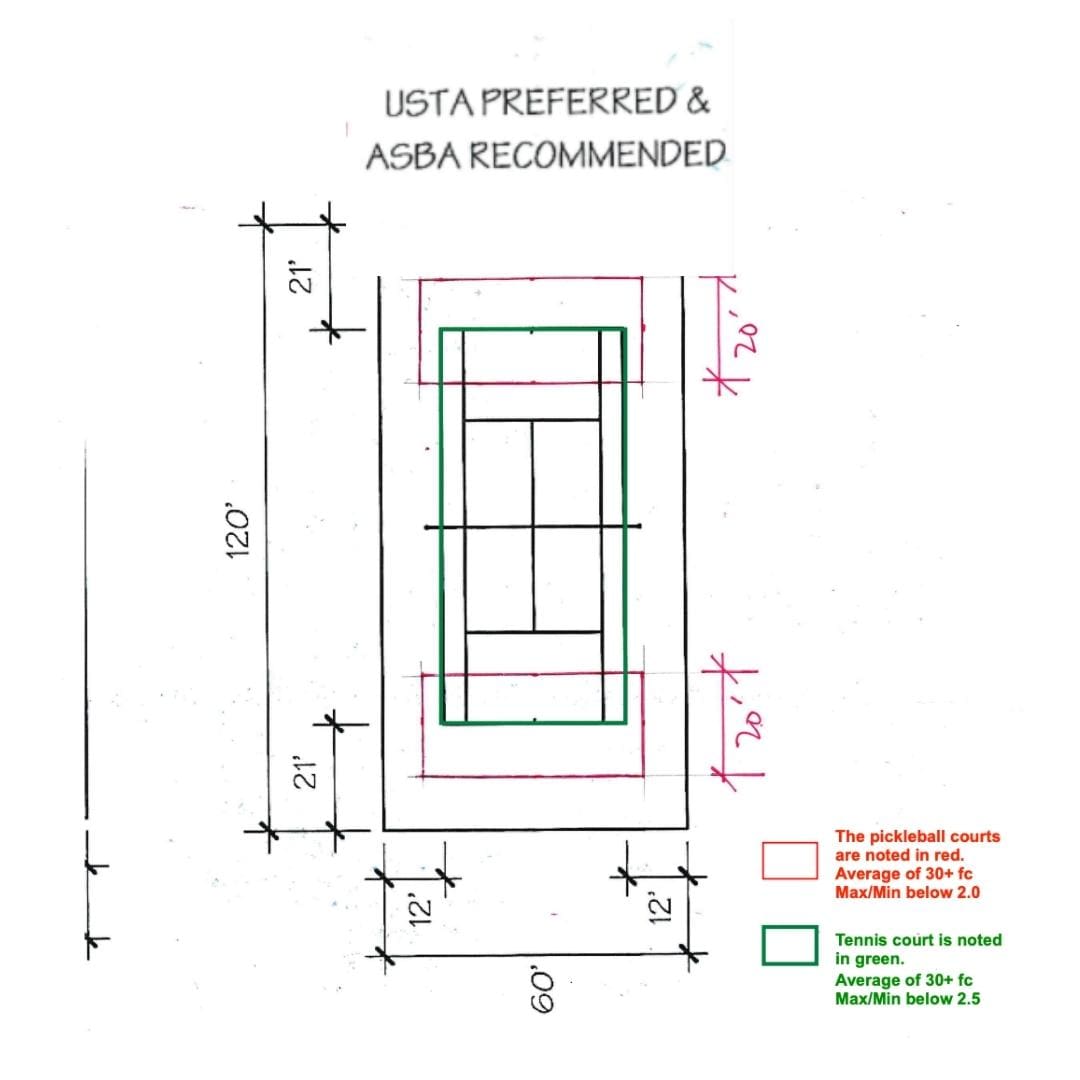
Is it possible to have a tennis court and two pickleball courts in the same court area and to properly illuminate both with pickleball lights? Yes, it is possible, and here’s how you can achieve it with the right lighting for pickleball courts.
To set up a tennis court and two pickleball courts in the same area, begin by arranging the tennis court with its permanent net in the center. This permanent tennis net will not interfere with the pickleball courts. Next, position the two pickleball courts on either side of the tennis net, ensuring that both courts fit comfortably within the boundaries of the tennis court.
Pickleball is played using a temporary or removable net, which can be easily set up when needed and taken down after play. This flexibility allows the court to be used for both sports, although you cannot play tennis and pickleball simultaneously due to the net configurations and space requirements.
Proper illumination is essential for both tennis and pickleball. Ensure that you use high-quality pickleball lights designed to cover the entire court area adequately, providing clear visibility for players regardless of which sport is being played. Pickleball lights are crucial for evening or night play, ensuring the court is well-lit and safe for both tennis and pickleball activities. For outdoor courts, lighting quality is especially important to minimize glare, shadows, and light trespass, ensuring optimal visibility and safety. By installing pickleball lights, you can optimize your court space to accommodate both sports effectively, enhancing the playing experience for everyone.
Tennis and Pickleball
Illuminating all three courts (one tennis court and two pickleball courts) properly is feasible and crucial for optimal play. For club-level lighting, a tennis court requires over 30 footcandles (fc) of light with a max/min ratio below 3.0. The max/min ratio measures the evenness of lighting on the court, calculated by dividing the maximum light level by the minimum light level. A lower max/min ratio indicates more uniform lighting, enhancing visibility and playability. Lighting uniformity is essential because it ensures that every part of the court is evenly illuminated, reducing shadows and glare that can affect player performance.
For pickleball, the USA Pickleball Association (USAPA) standards also specify 30 fc, but with a stricter max/min ratio below 2.0. This lower ratio is necessary because the smaller pickleball is more challenging to see in motion, requiring more consistent lighting across the court. When considering how much light is needed, it's important to note that more light may be required for higher skill levels or competitive play to ensure optimal visibility and meet advanced standards.
By meeting these lighting standards for both sports, you ensure that players have a clear and even view of the court, improving performance and safety during play.
Tennis and Pickleball Court Lighting
The photometric study for these courts evaluates the lighting performance to ensure it meets the necessary standards for both tennis and pickleball. Direct lighting is crucial in this setup, as it delivers bright and uniform illumination directly onto the court surface. For the tennis court, designed to club-level standards, the study shows an average illumination of 34 footcandles (fc) with an impressively low max/min ratio of 1.73. This low ratio indicates that the lighting is exceptionally even, providing consistent visibility across the entire court, which would satisfy even the high standards of a country club. Custom lighting designs are essential to achieve these results, and using online tools to create lighting designs tailored to each court ensures optimal performance and compliance with standards.
For the pickleball courts, the lighting also exceeds the USA Pickleball Association (USAPA) standards. Indirect lighting solutions are beneficial here, as they are designed to provide minimal glare and enhance visual comfort by reflecting light off ceilings. The average illumination is 31 fc, and the max/min ratio is an impressive 1.68. This means that the lighting meets the required light level, and ensures extraordinary evenness, making the court well-lit and suitable for competitive play. This consistency in lighting helps players see the ball clearly, enhancing the overall playing experience.
Dark Sky Compliant Tennis and Pickleball Lights
Dark sky compliant lighting is designed to protect the night sky by minimizing light pollution and reducing the impact of artificial lighting on the surrounding environment. For tennis and pickleball courts, using dark sky compliant LED lights means players benefit from reduced glare and improved visibility, while neighbors and wildlife are shielded from excessive light. These lighting fixtures feature full cutoff optics, which direct light precisely onto the court surface and prevent unwanted upward illumination. By choosing dark sky compliant LED lights, facilities can achieve excellent energy efficiency and meet local lighting ordinances, all while providing a superior playing experience. This approach not only supports environmental stewardship but also ensures that your court lighting system operates efficiently and responsibly.
From an environmental standpoint, the design of the lighting for the tennis and pickleball courts is dark sky compliant. This means the lighting minimizes light pollution, preserving the natural night sky. Additionally, the use of reflected light, which directs light upward towards reflective surfaces, reduces glare and enhances visual comfort by creating a soft, diffused lighting effect. The photometric study specifies a color temperature of 3000 Kelvin (K), the maximum allowed for dark sky compliance. Color temperatures, measured in Kelvin, affect the appearance of the light; higher color temperatures can result in a bluish tint, while lower temperatures, like 3000K, emit a warm, soft light that is less disruptive to wildlife and reduces glare and skyglow. The luminaire correlated color temperature (CCT) is carefully selected to ensure optimal visual comfort and environmental sensitivity.
If environmental compliance is not a primary concern and a whiter, brighter light is preferred, higher Kelvin options are available. These higher Kelvin lights, with a higher luminaire correlated color temperature (CCT), still feature a full cutoff design, directing light downward to minimize spill and glare. However, they will not meet Dark Sky compliance standards. Using higher Kelvin lighting can enhance visibility and provide a different aesthetic, but it may contribute more to light pollution and may introduce a bluish tint compared to the 3000K compliant lights.
Tennis and Pickleball Court Light Fixtures
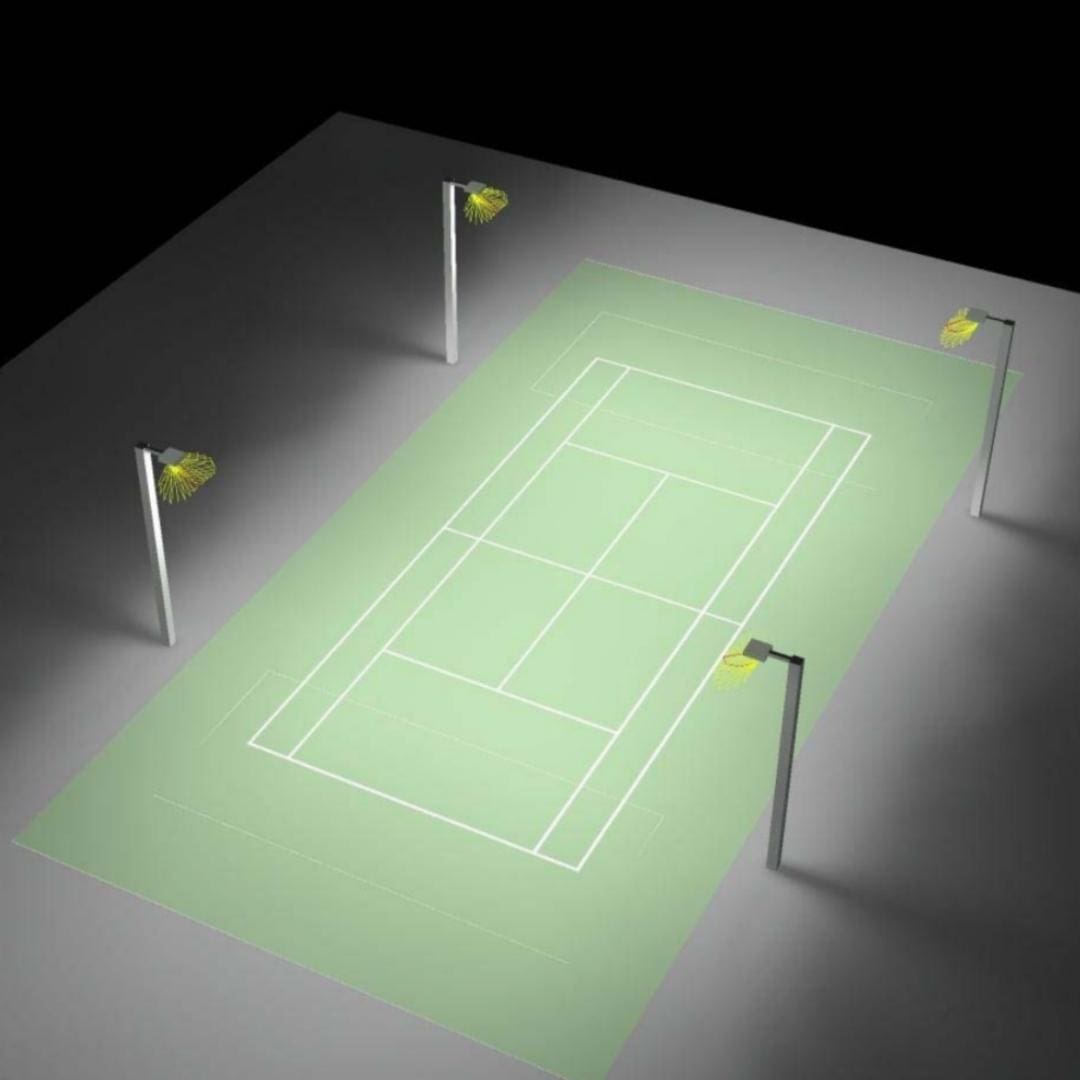
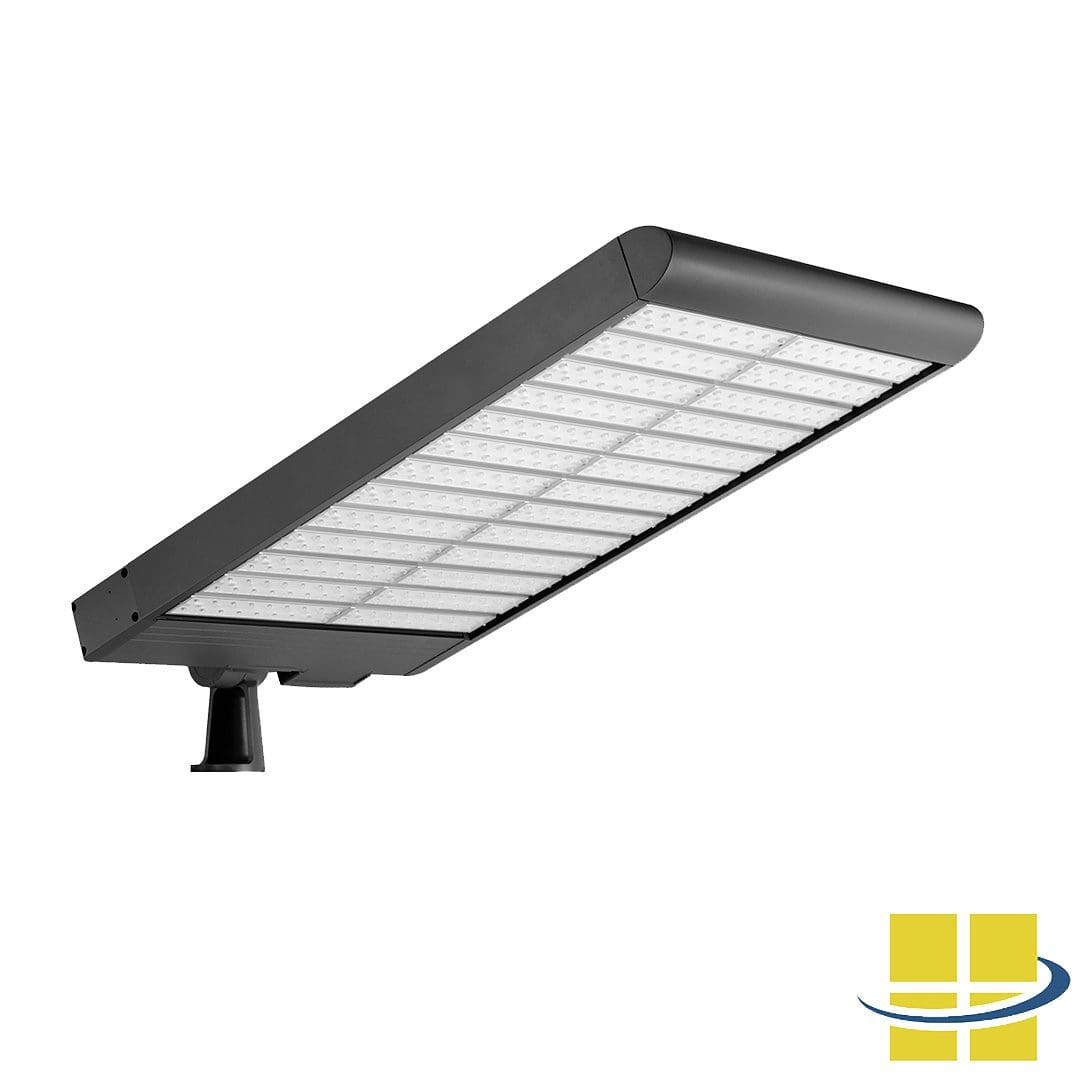
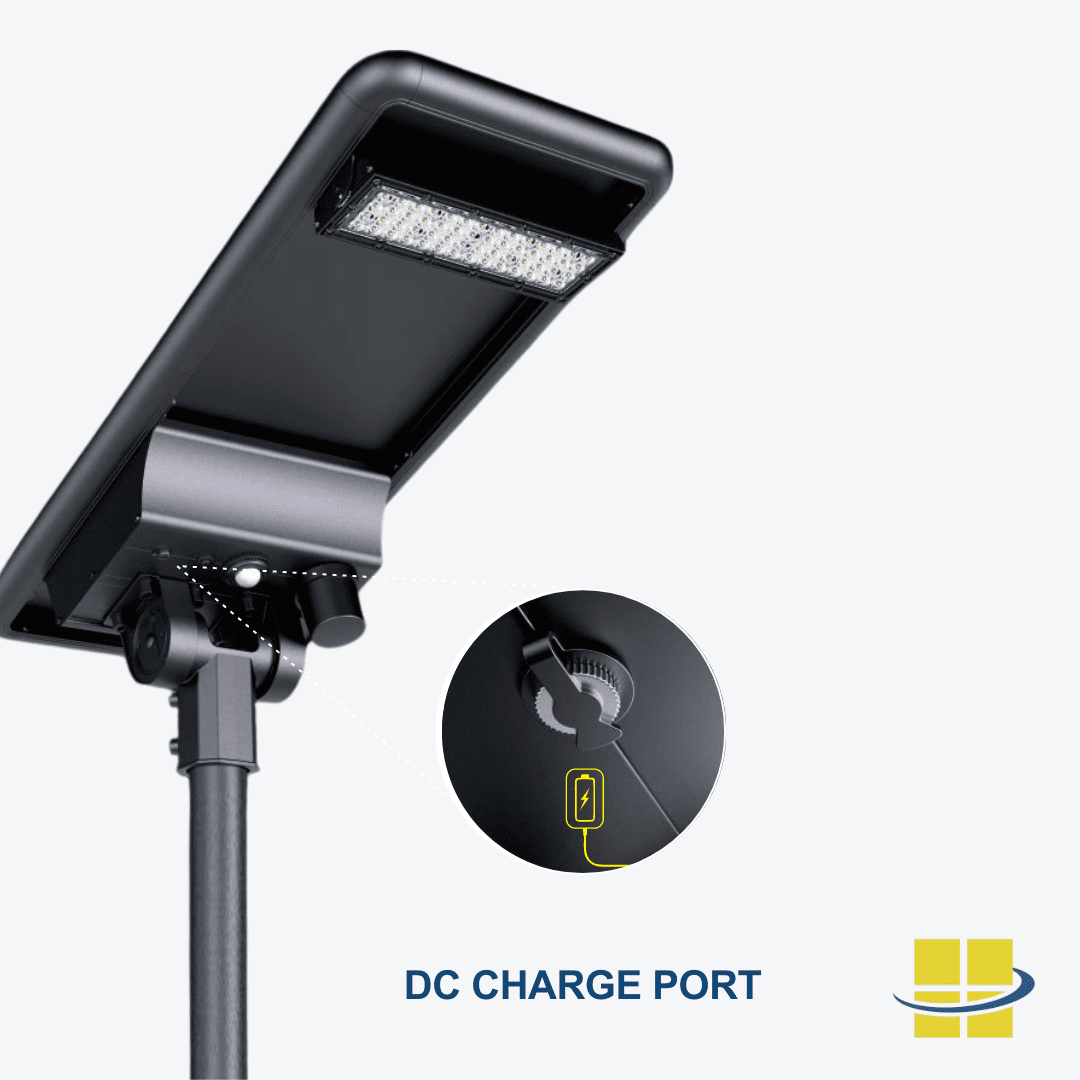
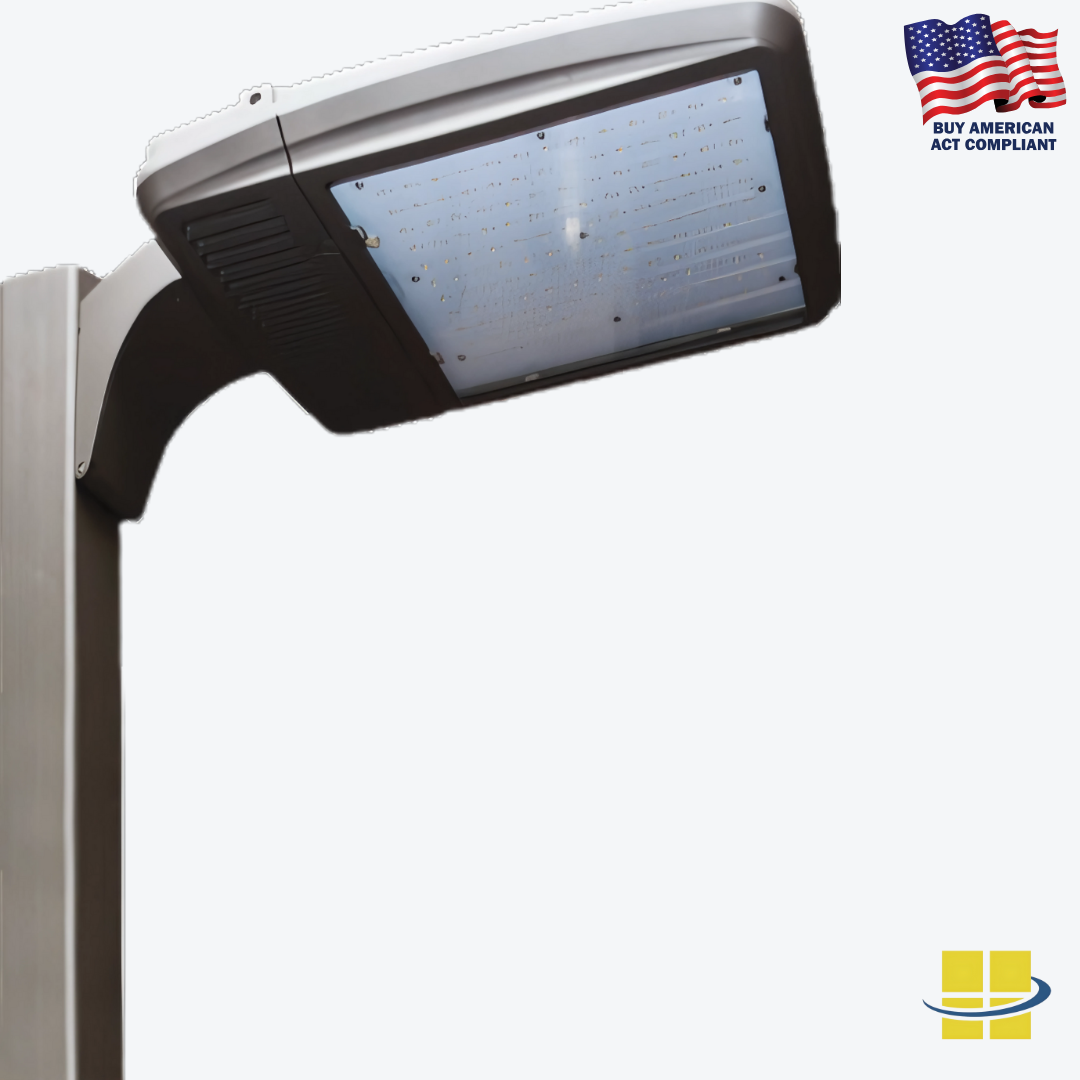
The sports luminaire used for these courts is an ASTA. Pickleball light poles are essential for outdoor pickleball court lighting solutions, ensuring proper illumination and aesthetic compliance. ASTAs are IP66 rated, which means they are submersible, and IK10 rated for impact. ASTAs are EXTREME LIFE rated L70 @ 200,000 hours of life and provide over 300,000 lumens. They are quite durable, too, as ASTAs do not have glass lenses. There is nothing to shatter. If anything ever damaged an ASTA, such as a flying piece of debris during a hurricane, in the unlikely case that one light module was destroyed, the remainder would stay on, and ASTAs are field-repairable. ASTAs are available in 2200K, 3000K, 4000K 5000K, and 5700K with an optional emergency power supply. ASTA fixtures can also be configured to meet Class III lighting standards for tennis and pickleball courts, ensuring compliance with recommended illumination levels.
ASTAs come with custom optics, so they are purpose-built to meet the lighting requirements of the application. ASTAs also have inexpensive options that enhance performance. Recommended options for the ASTA lights LED are as follows:
Backlight Shields – These stop the light from being emitted behind the poles. For a minimal cost, it stops light pollution.
Bird Spikes – This stops birds from nesting on the top of the ASTAs and reduces bird droppings on the courts. It also stops the nest from insulating the fixture and causing the fixture to retain heat.
Marine Grade Finish – This is a must for locations by the ocean. It increases the protection of the metal on the fixture.
Surge Protection – 10-Ka surge protection protects the driver from surges in the power grid. Surge protection protects the light fixtures in locations such as islands with unstable voltage and traditional industrial locations with voltage spikes.
Benefits of LED Lighting for Pickleball Courts
LED lighting offers numerous benefits for pickleball courts, making it an ideal choice for players and facility owners alike. Some of the key advantages of LED lighting for pickleball courts include:
-
Energy Efficiency: LED lights use up to 75% less energy than traditional metal halide lights, resulting in significant cost savings and reduced environmental impact. Typical energy savings when switching from HID to LED lighting systems range from 40-60%, especially when combined with advanced control systems and design tools to optimize efficiency. This makes LED lighting a sustainable choice for both residential and commercial installations.
-
Longer Lifespan: LED lights have a longer lifespan, lasting up to 200,000 hours or more, compared to metal halide lights which typically last around 10,000 to 20,000 hours. This means fewer replacements and lower maintenance costs over time.
-
Improved Visibility: LED lights provide better color accuracy and consistency, making it easier for players to see the ball and the court. This is crucial for maintaining high levels of play and ensuring a competitive game environment.
-
Reduced Maintenance: LED lights are more durable and resistant to shock and vibration, reducing the need for frequent replacements and maintenance. This durability is especially beneficial for outdoor pickleball courts exposed to various weather conditions.
-
Instant-On Capability: LED lights turn on instantly, eliminating the need for warm-up time and allowing players to start their games quickly. This feature is particularly useful for facilities with high usage rates, ensuring that courts are always ready for play.
Cost Savings and Financial Benefits
Switching to LED lighting solutions for pickleball and tennis courts offers substantial cost savings and long-term financial benefits. LED lights are significantly more energy efficient than traditional metal halide lights, often using up to 75% less electricity. This translates into lower utility bills and a reduced carbon footprint for your facility. Additionally, LED fixtures have a much longer lifespan, which means fewer replacements and less frequent maintenance—further driving down operational costs. By investing in the right lighting solutions, facility owners can enjoy both immediate and ongoing cost savings, making LED lighting a smart choice for any lighting project. The combination of energy efficiency, durability, and minimal maintenance ensures that your lighting investment delivers value year after year.
Lighting Design Considerations
When designing a lighting system for a pickleball court, there are several factors to consider to ensure optimal illumination and safety. Some of the key considerations include:
-
Ensuring compliance with local lighting requirements to meet regulations on light trespass, dark sky standards, and overall lighting quality.
-
The height and placement of light poles to minimize shadows and glare.
-
The type of fixtures used, such as LED or metal halide, for energy efficiency and durability.
-
The color temperature and brightness of the lights to provide clear visibility without causing discomfort to players or neighbors.
Levels of Play
Pickleball caters to players of varying skill levels, and each level of play comes with its unique set of requirements. Lighting plays a pivotal role in catering to these needs. When designing lighting for regulation pickleball courts, it is important to consider the minimum total playing surface required by official court standards, as this impacts both the layout and effectiveness of the lighting system. For example:
-
Recreational Players: Recreational players may require lower light levels, around 20-30 footcandles, to provide a comfortable and enjoyable playing experience. This level of lighting is sufficient for casual games and social play.
-
Competitive Players: Competitive players may require higher light levels, around 40-50 footcandles, to provide optimal visibility and reduce eye strain. This ensures that players can perform at their best and maintain a high level of play.
-
Professional Players: Professional players may require even higher light levels, around 60-80 footcandles, to provide broadcast-quality television lighting. This level of lighting ensures that games can be televised with clear visibility and minimal shadows, enhancing the viewing experience for audiences.
Color Temperature
Choosing the right color temperature is crucial for enhancing visibility and minimizing distortion of the pickleball’s color. Correlated Color Temperature (CCT) signifies the predominant color tone of a light source. For pickleball courts:
- Cooler Light Sources (5000K-6500K): These are recommended for commercial or public installations, as they provide a bright and energizing atmosphere. Cooler light sources enhance visibility and create a professional playing environment.
- Warmer Light Sources (3000K-4000K): These are recommended for residential installations, as they provide a cozy and relaxing atmosphere. Warmer light sources are ideal for home courts where comfort and ambiance are prioritized.
Broadcast Quality Television Lighting
For facilities that host televised pickleball or tennis events, broadcast quality television lighting is a must. This level of lighting ensures that every serve, volley, and rally is captured in vivid detail for viewers at home. LED lighting is the preferred choice for broadcast applications due to its high color rendering index (CRI), which delivers accurate and vibrant color representation on camera. With advanced LED lighting, courts can achieve the specific lighting illumination levels and uniformity required for professional broadcasts, eliminating shadows and providing consistent light coverage. Investing in broadcast quality television lighting not only enhances the experience for athletes and spectators but also elevates the reputation of your facility, making it an attractive venue for high-profile tournaments and televised matches.
Safety and Visibility
Safety and visibility are top priorities when it comes to pickleball court lighting. Proper lighting ensures the safety of players by preventing accidents and injuries, and provides optimal visibility to enhance the overall game experience. Some of the key considerations for safety and visibility include:
-
Light Intensity: The right light intensity is crucial for an optimal playing experience. Determine the required lumens for your court size to achieve perfect visibility. This ensures that players can see the ball clearly and react quickly during play.
-
Light Distribution: Proper light distribution is essential to minimize shadows and glare. This ensures uniform lighting across the court and prevents any unfair advantages due to poor visibility. Even light distribution enhances the overall playing experience and reduces eye strain.
-
Pole/Light Placement: Proper placement of lights is essential to minimize shadows and glare. This ensures uniform lighting across the court and prevents any unfair advantages due to poor visibility. Strategic placement of light poles and fixtures ensures that the entire court is well-lit and safe for play.
By considering these factors and choosing the right LED lighting solution, pickleball court owners and players can enjoy a safe, enjoyable, and competitive game experience. It is also recommended to perform periodic visual inspections of lighting fixtures to ensure proper operation and longevity.
Tennis Court and Pickleball Court Poles
Among the other pickleball kits and items offered, this lighting package uses (4) 20’ light poles. The choice of pole can be made of steel, aluminum, or fiberglass, and are available in different colors. Many poles need to be designed to withstand local conditions including wind speed and salt water. For example, a pickleball court in the Florida Keys has salt water come up and over the court during hurricanes. The poles had to be built to bolt down to existing bolts and withstand salt water. We manufactured fiberglass poles with bolt-down stainless steel bases to meet the requirements. Courts in the Cayman Islands required poles that would not degrade in salt air, could only be bolted down to attach to solid rock terrain, and had to withstand 180mph winds. Again the solution was fiberglass poles.
Minimizing Light Trespass
Minimizing light trespass is essential for maintaining good relationships with neighbors and protecting the night sky from unnecessary light pollution. In pickleball and tennis court lighting design, this is achieved through the use of full cutoff LED fixtures, precise fixture directing light only where it’s needed, and thoughtful placement of light poles. LED lights are especially effective for this purpose, as their directional nature allows for targeted illumination with minimal spill. By implementing a lighting system that controls light distribution and limits upward and outward light, facilities can comply with local lighting ordinances, reduce light trespass, and create a more sustainable and community-friendly environment. Proper lighting design not only enhances playability but also demonstrates a commitment to responsible sports lighting practices.
Additional Pickleball Court LED Lighting Resources
Conclusion
Combining tennis and pickleball courts in a single area is both practical and efficient when utilizing proper lighting design. High-quality, dark sky compliant lights ensure clear visibility and safety for both sports, enhancing the playing experience. Durable fixtures like ASTA luminaires offer long-lasting reliability and performance, even in extreme conditions. By following these guidelines, you can create a versatile and environmentally friendly sports facility that meets the highest standards for both tennis and pickleball.
Pickleball Lights Frequently Asked Questions (FAQs)
You have Pickleball Court Lighting questions. We have answers. If you have a question that isn’t answered below, contact an Access Fixtures lighting specialist at (800) 468-9925 or click here to visit our customer service page.
Do pickleball court lighting systems use motion sensors?
Yes, many modern pickleball court lighting systems incorporate motion sensors as part of their lighting control systems. Motion sensors help optimize energy efficiency by activating the lights only when players are present or movement is detected on the court. This ensures proper illumination during gameplay while conserving energy when the court is not in use.
What is a typical control system for pickleball court lighting?
A typical control system for pickleball court lighting includes components such as scheduling, photocells, and motion sensors. These elements work together to automate lighting operation, improve energy savings, and prolong the lifespan of the fixtures. Scheduling allows lights to turn on and off at set times, photocells respond to ambient light levels, and motion sensors activate lights when movement is detected.
Do you sell lights specifically designed for pickleball courts?
Yes, we sell lights that are specifically designed for outdoor pickleball courts. Our lighting solutions are tailored to different court sizes and requirements. We also provide design tools and technical support to help you choose and implement the right lighting system for your pickleball court.
Can you play tennis and pickleball simultaneously on the same court?
No, due to net configurations and space requirements, simultaneous play is not possible.
What are the lighting standards for tennis courts?
Tennis courts need over 30 footcandles (fc) with a max/min ratio below 3.0.
What are the lighting standards for pickleball courts?
Pickleball courts require 30 fc with a max/min ratio below 2.0.
What does dark sky compliant mean?
Dark sky compliant lighting minimizes light pollution, using a maximum color temperature of 3000 Kelvin (K). This helps preserve the natural night sky, reduces glare, and is less disruptive to wildlife.
What are ASTA luminaires?
ASTA luminaires are durable, IP66-rated, extreme life-rated lighting fixtures designed for sports. They are submersible, field-repairable, and feature custom optics to meet specific lighting needs.
What additional options are available for ASTA fixtures?
Recommended options include backlight shields to prevent light pollution, bird spikes to stop birds from nesting and reduce heat retention, marine-grade finishes for coastal protection, and surge protection for areas with unstable power grids.
What materials are used for lighting poles in various conditions?
Although not kept in stock, you can choose between a steel pole, aluminum pole, or fiberglass pole depending on project requirements. They are customized to withstand local conditions such as wind speed and saltwater exposure, ensuring durability and stability. Access Fixtures provides lighting brackets, poles, and mounts to suit your project needs.
How do you achieve proper illumination for both tennis and pickleball courts?
Use high-quality pickleball lighting designed to cover the entire court area adequately. This ensures clear visibility and safety for both sports, enhancing the overall playing experience.
What are the benefits of dark sky compliant lighting?
Dark sky compliant lighting reduces light pollution, preserves the natural night sky, and minimizes disruption to wildlife. It also reduces glare and skyglow, creating a more pleasant and sustainable environment.
Why is a lower max/min ratio important for lighting?
A lower max/min ratio ensures more uniform lighting across the court. This enhances visibility and playability by reducing shadows and glare, providing a consistent lighting experience for players.