
Pickleball is growing in popularity, and proper lighting is crucial for evening and nighttime play. When it comes to lighting options, including the cost of pickleball court lighting, two main choices are solar-powered lighting and traditional grid-connected lighting. This article provides a detailed comparison of these two lighting solutions, helping you make an informed decision for your pickleball court lighting project. Direct lighting, achieved through ceiling-mounted fixtures, provides bright and uniform illumination essential for gameplay. For indoor pickleball courts, proper lighting requirements and design considerations, such as optimal fixture placement and sufficient ceiling height, are crucial to ensure visibility and meet the technical specifications for indoor play.
Key Takeaways
-
-
Initial Installation Costs: Grid-connected systems are cheaper to install. Solar LED lights need extra expenses for panels, batteries, and mounting, resulting in higher upfront costs.
-
Operational and Maintenance Costs: Solar lights have minimal operational costs by using sunlight, while grid-connected systems have ongoing electricity expenses. This makes solar lighting more cost-effective long-term.
-
Environmental Impact and Energy Independence: Solar LED pickleball lighting reduces carbon emissions and offers energy independence, ideal for remote or unstable grid areas. Grid-connected systems use non-renewable energy, contributing to greenhouse gases.
-
Understanding Pickleball Court LED Lighting
Importance of Proper Lights for Pickleball Courts
Proper court lighting is crucial for ensuring safety, visibility, and enjoyment during evening pickleball games. High-quality LED pickleball lighting ensures optimal illumination, enhancing player performance by providing clear visibility of the ball and court while significantly reducing the risk of accidents and injuries. Well-illuminated courts create an environment where players can focus on the game without straining their eyes, leading to a more enjoyable and competitive experience.
Types of LED Pickleball Court Lighting
When it comes to lighting your pickleball court, there are two main options to consider:
-
Solar Pickleball Court LED Lighting: This type of LED light solution utilizes solar panels to capture and store energy from the sun, which is then used to power the lighting fixtures. It is an eco-friendly option that operates independently of the power grid.
-
Grid-Connected Pickleball Court Lighting: This traditional lighting solution draws electricity from the local power grid. It offers consistent and reliable illumination through light fixtures unaffected by weather conditions or daylight availability. Outdoor pickleball court lighting fixtures are typically mounted on tall poles to ensure even illumination and weather resistance.
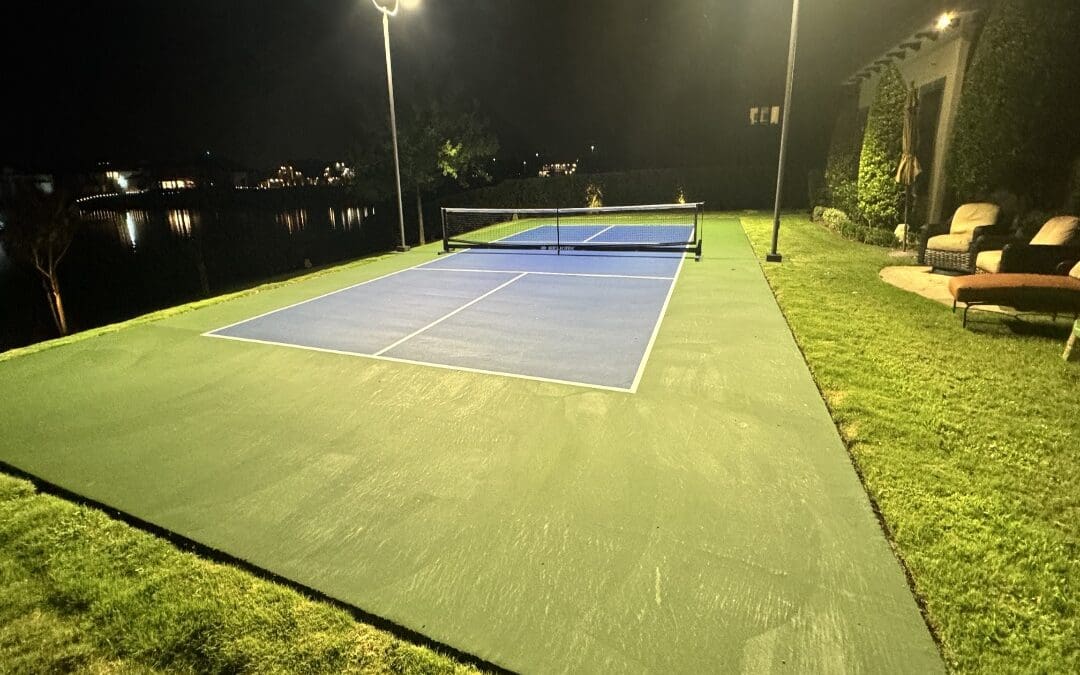
Pickleball Court Illuminated with Four (4) ASTA 300w Fixures | Access Fixtures
Recommended Foot Candles for Pickleball Courts
When it comes to lighting pickleball courts, achieving the right illumination levels is crucial for both safety and performance. The recommended foot candles for pickleball courts vary depending on the level of play and whether the court is indoors or outdoors.
For indoor courts, the recommended foot candles are:
- 20-30 foot candles for recreational play
- 30-40 foot candles for competitive play
- 40-50 foot candles for professional or high-level play
For outdoor courts, the recommended foot candles are:
- 30-40 foot candles for recreational play
- 40-50 foot candles for competitive play
- 50-60 foot candles for professional or high-level play
These guidelines ensure that players have optimal visibility, which is essential for tracking the ball and maintaining a high level of play. The specific lighting requirements may vary based on the court’s size, the type of lighting fixtures used, and the level of play. Ensuring the correct lighting levels can significantly enhance the playing experience and reduce the risk of accidents.
Color Temperature for LED Pickleball Court Lights
The color temperature of LED pickleball court lights plays a significant role in the overall ambiance and visibility of the court. The most common color temperatures for LED pickleball court lights are:
- 4000K: This warm white color temperature is often used for residential or recreational pickleball courts. It provides a soft, warm glow that is easy on the eyes, creating a comfortable playing environment.
- 5000K: This cool white color temperature is typically used for commercial or competitive pickleball courts. It offers a bright, crisp light that enhances visibility, making it ideal for high-level play.
Some LED pickleball court lights also come with color-adjustable options, allowing users to customize the color temperature to suit their specific needs. Choosing the right color temperature can improve player performance and comfort, ensuring a better overall experience on the court.
Lighting Codes and Standards for Pickleball Courts
Lighting codes and standards are essential for ensuring that pickleball courts provide a safe, enjoyable, and high-quality playing experience. Organizations such as the Illuminating Engineering Society (IES) and the International Association of Lighting Designers (IALD) have established guidelines specifically for sports lighting, including pickleball court lighting. These standards outline the minimum recommended illuminance levels, uniformity ratios, and glare control measures necessary to achieve optimal playing conditions.
For recreational play on pickleball courts, the IES recommends a minimum average horizontal illuminance of 30 foot-candles (fc), while competitive play should aim for at least 50 fc. Achieving these light levels ensures that players can see the ball and court lines clearly, reducing the risk of accidents and enhancing gameplay. In addition to brightness, uniform illumination across the entire court is critical. A uniformity ratio of at least 0.6 is advised to prevent dark spots and ensure consistent visibility, allowing for fair and enjoyable matches.
By adhering to these lighting codes and standards, facility owners and designers can create pickleball courts that support both recreational play and competitive play, providing optimal playing conditions for all participants.
Comprehensive Comparison of Solar and Grid-Connected Pickleball Court Lighting
Fixture Output
- Solar Lighting: Solar fixtures generally produce less light output compared to grid-connected fixtures. However, advancements in LED technology have significantly improved the efficiency and brightness of solar lighting. Proper planning and placement of fixtures can help maximize the effectiveness of solar lighting, ensuring adequate illumination for pickleball courts. Energy-efficient control systems ensure the lighting system operates only when the court is in use, maximizing energy savings.
- Grid-Connected Lighting: Grid-connected fixtures tend to offer higher and more consistent light output. They are not constrained by weather conditions or daylight availability, making them a reliable choice for ensuring the court is well-lit for evening and nighttime play.
Installation Location (Trees)
- Solar Lighting: Solar lighting systems can be installed in various locations, including areas with partial shading from trees. However, to ensure optimal performance, it’s essential to place solar panels in locations that receive maximum sunlight exposure throughout the day. Strategic placement away from extensive shading is crucial to maintain the efficiency of the system.
- Grid-Connected Lighting: Grid-connected lighting systems offer more flexibility in installation locations. Since they do not rely on solar energy, fixtures, including pickleball light poles, can be placed under trees or in shaded areas without compromising performance. This flexibility can be particularly beneficial in environments with dense tree coverage or limited open space.
Initial Installation Cost
- Solar Lighting: The initial installation cost for solar lighting systems is generally higher. This cost includes solar panels, batteries, mounting structures such as light poles, and wiring. Additionally, professional installation is often recommended to ensure the system’s efficiency and safety. Despite the higher upfront costs, solar systems can provide long-term savings due to minimal operational costs. When installing lighting systems for an outdoor pickleball court, it is crucial to consider weather-resistant fixtures to ensure durability and optimal performance.
- Grid-Connected Lighting: Grid-connected systems typically have lower initial installation costs. The main expenses include the lighting fixtures, electrical wiring, and potentially some trenching for underground cables. Connecting to the existing power grid usually requires less specialized equipment and labor compared to solar systems, resulting in lower upfront costs.
Detailed Comparison
| Aspect | Solar Pickleball Court Lighting | Grid-Connected Pickleball Court Lighting |
|---|---|---|
| How It Works | Utilizes photovoltaic panels to capture sunlight, storing energy in batteries for nighttime use. | Draws electricity from the local power grid using traditional wiring and infrastructure. |
| Benefits | Eco-friendly, cost-effective, energy independent. | Consistent power supply, lower initial cost, simple maintenance. |
| Challenges | Higher initial cost, weather dependent, battery maintenance required. | Higher operational costs, environmental impact, dependency on grid. |
| Installation Process | Involves setting up solar panels, wiring, battery storage, and lighting fixtures. Professional installation recommended. | Involves electrical wiring, setting up light poles, and connecting to the power grid. Requires coordination with local utilities. |
| Maintenance Requirements | Regular cleaning of panels, checking battery health, ensuring secure connections. | Regular inspection of electrical components, ensuring intact wiring, replacing bulbs/fixtures. |
| Initial Installation Costs | Generally higher due to solar panels and battery storage. | Lower upfront costs but may require extensive wiring. |
| Operational Costs | Minimal operational costs. | Ongoing electricity expenses. |
| Long-Term Savings | Significant long-term savings due to reduced electricity bills and potential government incentives. | Lower long-term savings due to ongoing electricity costs. |
| Environmental Impact | Reduces carbon emissions, promotes sustainability with renewable energy sources. | Relies on non-renewable energy, contributing to greenhouse gases. |
| Lighting Quality | Can provide high-quality lighting but may be less reliable in poor weather conditions. | Consistent high-quality lighting unaffected by weather conditions. |
| Specific Lighting Illumination Levels | May require careful planning to achieve specific lighting illumination levels for optimal visibility and gameplay experience. | Easily achieves specific lighting illumination levels, enhancing visibility and improving gameplay experience. |
| Reliability | Dependent on sunlight, less reliable in areas with frequent cloud cover/long winters. | Generally more reliable but dependent on local power grid stability. |
| Site Assessment | Requires assessment for sunlight exposure. | Requires proximity to the power grid. |
| Professional Installation | Requires expertise in solar technology. | Requires certified electricians. |
| Routine Maintenance | Regular panel cleaning and battery checks. | Periodic electrical inspections and bulb replacements. |
| System Durability | Can last 20-25 years with proper maintenance. | Durable but may require more frequent component replacements. |
| Energy Independence | Offers energy independence, ideal for remote locations or areas with unstable power grids. | Relies on the local power grid, susceptible to outages. |
Lighting Safety and Security Considerations
Safety and security are top priorities when designing lighting systems for pickleball courts, especially for outdoor installations. One of the main concerns is controlling light spill and light trespass, which can affect neighboring properties and disrupt the surrounding environment. To address this, LED lights with specialized optics such as Type III or Type V are used to precisely control the beam angle, ensuring that light is directed only where it is needed on the court.
Glare reduction is another important factor. Excessive glare can distract players and reduce visibility, impacting both safety and performance. Using LED fixtures equipped with glare shields or louvers, and mounting hardware that allows for precise aiming, helps minimize glare and light spill. Adjustable arms or brackets make it possible to fine-tune the direction of the light, further enhancing the effectiveness of the lighting system.
Regular maintenance, including cleaning and inspecting the LED lighting and mounting hardware, is essential to ensure the system continues to perform reliably. By prioritizing these safety and security considerations, facility owners can create well-lit, secure, and comfortable pickleball courts for all users.
Scenario: Cost Savings Comparison Between Solar and Grid-Connected Lighting
Overview
In this scenario, we compare the long-term cost savings of using solar-powered LED lamps versus grid-connected LED fixtures for a pickleball court. We will use two specific fixtures from Access Fixtures for this comparison:
Cost Comparison Table: Grid-Connected vs. Solar Lighting
| Category | Grid-Connected Lighting | Solar Lighting |
| Fixture Cost | $649.87 per fixture | $1,099.87 per fixture |
| Number of Fixtures | 2 | 2 |
| Total Fixture Cost | $1,299.74 | $2,199.74 |
| Electrician & Apprentice | $700 | N/A |
| Equipment Rental | $200 | N/A |
| Trench Digging Labor | $2,000 | N/A |
| Trench Digging Permit | $150 | N/A |
| Fill Dirt Finish | $100 | N/A |
| Electrical Permit | $100 | N/A |
| Installation of Solar Panels and Battery Systems | N/A | $500 |
| Total Installation Cost | $3,250 | $500 |
| Total Initial Cost | $4,549.74 | $2,699.74 |
| Annual Energy Consumption per Fixture | 584 kWh | N/A |
| Electricity Cost per kWh | $0.15 | $0 |
| Annual Electricity Cost per Fixture | $87.60 | $0 |
| Total Annual Electricity Cost for 2 Fixtures | $175.20 | $0 |
| Total Electricity Cost Over 5 Years | $876.00 | $0 |
| Annual Maintenance Cost per Fixture | $0 | $50 |
| Total Annual Maintenance Cost for 2 Fixtures | $0 | $100 |
| Total Maintenance Cost Over 5 Years | $0 | $500 |
| Total Cost Over 5 Years | $5,425.74 | $3,199.74 |
| Total Electricity Cost Over 10 Years | $1,752.00 | $0 |
| Total Maintenance Cost Over 10 Years | $0 | $1,000 |
| Total Cost Over 10 Years | $6,301.74 | $3,699.74 |
The solar lighting system becomes more economical than the grid-connected system when considering the lower operational costs and the potential for further cost savings in subsequent years.
While the solar LED pickleball court lighting layout has a higher initial cost, it becomes a cost-saving option in the long run due to negligible operational costs. For a 10-year period, the solar lighting system is more economical compared to the grid-connected system. Thus, for those looking to make a sustainable and long-term investment, solar lighting is the more cost-effective choice.
Impact Resistant LED Fixtures for Pickleball Courts
Given the high-impact nature of pickleball, it’s essential to use impact-resistant LED fixtures that can withstand the rigors of the game. When selecting fixtures for pickleball courts, look for those made from high-impact resistant materials such as polycarbonate or aluminum. These materials ensure durability and longevity.
Key features to consider include:
- High-impact resistant materials: Polycarbonate or aluminum construction to withstand impacts.
- Secure mounting systems: To prevent fixtures from being knocked out of place during play.
- Weather-resistant coatings: To protect fixtures from the elements, especially for outdoor courts.
Popular options for impact-resistant LED fixtures include:
- LED fixtures with Type III optics
- LED floodlights with adjustable arms
- LED linear fixtures with impact-resistant lenses
These fixtures are designed to provide reliable and durable lighting, ensuring that the court remains well-lit and safe for players.
Lighting Control and Automation Options
Modern lighting control and automation options can greatly enhance the efficiency and user experience of pickleball courts. Advanced control systems allow facility owners to schedule lighting, adjust brightness, and implement motion sensing to optimize energy efficiency and reduce maintenance costs.
For example, motion sensing technology can automatically activate the LED lights when players enter the court and turn them off when the court is empty, ensuring that energy is not wasted. Dimming controls provide the flexibility to adjust light levels and lumen output based on the time of day or the type of play lowering brightness for recreational play and increasing it for competitive matches.
By integrating these control systems with the LED lighting system, facility owners can achieve greater energy efficiency, extend the lifespan of their lighting system, and create a more sustainable and player-friendly environment on their pickleball courts.
Why a Photometric Study is Crucial in Pickleball Court LED Lighting
A photometric study is crucial before installing LED lighting for a pickleball court because it addresses key considerations such as fixture placement, mounting height, and how to distribute light evenly across the court. This study evaluates the distribution, intensity, and uniformity of light across the court, which are essential for player safety, visibility, and overall performance. A photometric study ensures that light is distributed evenly across the entire playing surface and court surface, minimizing shadows and glare. Indirect lighting produces reflected light on white or highly reflective ceilings, creating a soft, diffused lighting effect. Proper illumination helps players see the ball clearly, judge its speed and trajectory accurately, and reduces eye strain, enabling them to perform at their best. Furthermore, a photometric study helps identify and eliminate potential glare spots and shadows that can hinder visibility and lead to accidents.
In addition to enhancing gameplay, a photometric study ensures compliance with industry standards and local regulations, which often dictate specific lighting levels and uniformity ratios for sports courts. Evaluating uniform illumination on the playing surface is a key consideration for both safety and performance. This is particularly important for competitive play, where consistent lighting can impact the fairness and outcome of matches. The study also helps in selecting the right fixtures, their placement, and aiming angles, maximizing energy efficiency and reducing operational costs.
Importantly, a photometric study aids in making an informed decision between grid-connected and solar lighting fixtures. By understanding the specific lighting needs and the potential performance of each type of fixture, stakeholders can weigh the benefits and drawbacks of each option. This ensures the chosen lighting solution provides adequate illumination, is cost-effective, and meets sustainability goals. Ultimately, investing in a photometric study leads to a well-lit pickleball court that enhances player experience, safety, and energy efficiency, making it an indispensable step in the lighting installation process.
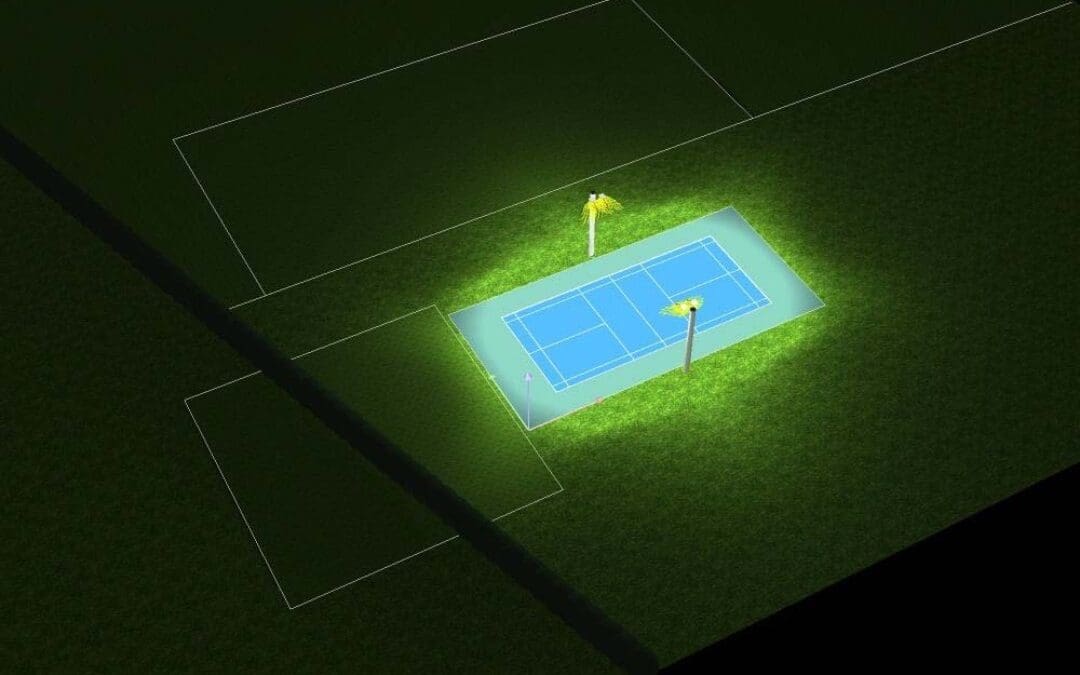
Photometric Study - 3D Rendering of Pickleball Court | Access Fixtures
Lighting and Player Performance
The quality of lighting on pickleball courts has a direct impact on player performance. Uniform illumination and reduced glare are essential for clear visibility, enabling players to track the ball accurately and react quickly during fast-paced games. High-quality LED lights with excellent color rendering indices (CRI) further enhance the visual experience, making it easier for players to distinguish court lines, the ball, and opponents’ movements.
Consistent performance and energy efficiency are hallmarks of modern LED lighting, ensuring that light levels remain stable throughout play and minimizing distractions caused by flickering or uneven lighting. By investing in advanced LED lighting systems, facility owners can promote better player performance, reduce eye strain, and create a more enjoyable and competitive environment for everyone on the court.
Lighting and Spectator Experience
Lighting doesn’t just benefit players—it also plays a crucial role in enhancing the spectator experience at pickleball courts. LED lights with adjustable beam angles and color temperatures can create a vibrant, immersive atmosphere that draws spectators into the action. Uniform illumination and reduced glare ensure that spectators have a clear view of the entire court, making it easier to follow the game and enjoy the excitement.
Energy-efficient LED lighting also helps reduce energy costs and supports sustainability, which can be appealing to environmentally conscious spectators and community members. By considering the needs of both players and spectators in the lighting design, facility owners can transform their pickleball courts into welcoming hubs for social activity, community engagement, and memorable sporting events.
Additional Considerations for Pickleball Court Lighting
When designing a lighting system for a pickleball court, several additional considerations can enhance the overall effectiveness and player experience. These include:
-
Glare control: Fixtures with glare shields or louvers can reduce glare, improving visibility and comfort for players. Selecting the correct mounting height for fixtures also reduces glare and enhances player comfort.
-
Light distribution: Consider whether symmetrical or asymmetrical light distribution is needed to ensure even illumination across the court.
-
Color rendering: High color rendering indexes (CRI) ensure that the colors of the court and players’ clothing are accurately represented, enhancing visibility and gameplay.
-
Dimming: Installing dimming controls allows for adjustments to the lighting level based on the time of day or the level of play, providing flexibility and energy savings.
By considering these factors, you can design a lighting system that meets the specific needs of your pickleball court, ensuring optimal performance and player satisfaction.
Indirect Lighting for Pickleball Courts
Indirect lighting is an excellent option for pickleball courts, providing a soft, even glow that minimizes glare and enhances visibility. Indirect lighting fixtures are designed to direct light upwards, where it is reflected off the ceiling or walls and then directed back down onto the court.
Popular options for indirect lighting include:
- LED linear fixtures with indirect lenses
- LED panel lights with indirect mounting options
- LED ceiling-mounted fixtures with indirect lighting distributions
Indirect lighting is particularly beneficial for courts that require high levels of illumination while minimizing glare. This type of lighting creates a comfortable playing environment, allowing players to focus on the game without straining their eyes.
By incorporating indirect lighting into your pickleball court design, you can achieve a well-lit, visually comfortable space that enhances the overall playing experience.
Additional Pickleball Court LED Lighting Resources
Conclusion
Proper lighting is essential for ensuring safety, visibility, and enjoyment during evening pickleball games. When choosing between solar and grid-connected lighting systems for pickleball courts, it's crucial to consider factors such as initial installation costs, operational and maintenance costs, and environmental impact. While solar lighting systems have higher upfront costs, they offer long-term savings and are more environmentally friendly. Grid-connected systems, on the other hand, provide consistent and reliable illumination with lower initial costs but higher ongoing expenses. Evaluating your specific needs, site conditions, and budget will help determine the best lighting solution for your pickleball court.
Solar vs Grid-Connected LED Pickleball Lighting Frequently Asked Questions (FAQs)
You have Pickleball Court Lighting questions. We have answers. If you have a question that isn’t answered below, contact an Access Fixtures lighting specialist at (800) 468-9925 or click here to visit our customer service page.
What are the benefits of using solar lighting for pickleball courts?
Solar lighting is eco-friendly, reduces carbon emissions, offers long-term cost savings, and provides energy independence, making it ideal for remote locations or areas with unstable power grids.
How do solar lighting systems work?
Solar lighting systems use photovoltaic panels to capture sunlight and convert it into electrical energy, which is stored in batteries and used to power the lighting fixtures at night.
Are solar lighting systems reliable in all weather conditions?
Solar lighting systems depend on sunlight, so their reliability can be affected by weather conditions. Proper placement and adequate sunlight exposure are essential for optimal performance.
What are the initial costs associated with solar lighting systems?
The initial costs of pickleball court light fixtures include solar panels, batteries, mounting structures, and professional installation, which are generally higher compared to grid-connected systems.
What are the operational costs of grid-connected lighting systems?
Grid-connected lighting systems incur ongoing electricity costs, which add up over time, making them more expensive in the long run compared to solar systems.
How long do solar lighting systems last?
With proper maintenance, solar lighting systems can last 20-25 years, providing a durable and long-term lighting solution for pickleball courts.
What kind of maintenance do solar lighting systems require?
Regular maintenance includes cleaning solar panels, checking battery health, and ensuring secure connections to maintain optimal performance.
Can solar lighting systems be installed in shaded areas?
While solar lighting systems can be installed in areas with partial shading, optimal performance requires maximum sunlight exposure. Strategic placement away from extensive shading is crucial.
What are the environmental benefits of using solar lighting?
Solar lighting reduces carbon emissions and promotes sustainability by using renewable energy sources, contributing to a greener environment.
How do I decide between solar and grid-connected lighting for my pickleball court?
Consider factors such as initial costs, long-term savings, operational costs, environmental impact, and site-specific conditions. Evaluating your specific needs and budget will help you make an informed decision. Access Fixtures also provides a complete lighting kit or package designed to fit your specific requirements.