
 If it is time to purchase new flood or area lighting to illuminate a large outdoor area for sports, a parking lot, a port, or a freight terminal, the project will likely require the selection and installation of new light poles. How do you make the correct light pole selection, and why does effective projected area (EPA) matter? Let’s find out.
While many Access Fixtures tennis courts, basketball courts, and other LED sports lighting packages include poles, the poles in these standard packages may not suffice for your location. Why? First and foremost, luminaire or pole assemblies must be designed to ensure structural integrity during wind conditions specific to your location, taking into account factors such as air density and drag coefficient. Wind affects light poles by creating forces that can cause vibrations and stress on the structure, potentially leading to fatigue or failure if not properly addressed. Standard flood, area, or sports lighting packages from Access Fixtures are designed to meet 90 MPH wind speed requirements, though this threshold may need to be higher if you are located near the coast or in a particularly windy area. It is crucial that you consider your wind speed zone to make sure your fixtures and poles are equipped for your project. Other factors to consider when making your light pole selection are the types of luminaire you’re using, the quantity of those luminaries, and local building codes. Let’s explore the aspects of flood and area light pole selection and how to get it done right.
When determining the effective projected area (EPA) of a light fixture or pole, imagine viewing the object from different angles and observing the shadow it casts. This helps visualize how the projected surface area changes depending on the perspective, which is essential for accurate calculations.
How to Select the Right Light Pole?
Selecting the right light pole for your outdoor lighting project is about more than just aesthetics or cost it’s a matter of safety, durability, and long-term performance. One of the most important factors to consider is the Effective Projected Area (EPA), which plays a key role in determining whether a light pole can withstand wind loads at your project location. The EPA calculation involves measuring the projected surface area of the pole and all attached accessories, such as lighting fixtures and brackets, to determine the total EPA value. This value is essential for assessing the pole’s ability to resist wind forces and prevent pole failure, especially in areas with high wind speeds or unique air density conditions.
By understanding the wind speed and air density specific to your project location, you can accurately calculate the wind load that your light pole will need to withstand. This process ensures that the selected pole, along with its fixtures and accessories, is capable of handling the expected wind forces, reducing the risk of structural failure and enhancing overall safety. Taking the time to determine the correct EPA and wind load for your installation is a critical step in any outdoor lighting project, whether you’re illuminating a sports field, parking lot, or public space.
How Does the Type and Quantity of Luminaires Affect Light Pole Selection?
The type of luminaire, the quantity of luminaires per light pole, and the type of mounting bracket used to attach the luminaires to the poles all affect the structural requirements of a light pole. The type of luminaire makes an enormous difference, as each luminaire housing has a unique effective projected area (EPA), also known as effective projected area EPA. The EPA is the exposed surface area of a light fixture or bracket multiplied by a shape factor. An EPA can be calculated manually, but it is easier to check the luminaire specifications provided by the manufacturer. To determine the total EPA of a pole, an engineer will add the EPA of the light fixture multiplied by the quantity of light fixtures and the EPA of the mounting hardware times the quantity of each piece of hardware. The total weight of all the light fixtures and mounting hardware has to be added up, too. When calculating EPA, a specific formula is used to calculate EPA for each component, and it is important to measure the total surface area and values for each part to ensure accurate results. It is also important to consider how the fixture is mounted, as this can affect the overall stability and wind resistance. Any other brackets, signs, decorations, overhead wires, or other equipment that will be mounted on the light pole must be taken into consideration. If this all sounds confusing, don’t worry: An Access Fixtures lighting specialist will be glad to calculate the total EPA and weight factors for your project.
For example, if you are installing a street light with two fixtures (each with an EPA of 1.2 sq. ft.) and a mounting bracket with an EPA of 0.5 sq. ft., you would calculate the light pole's total EPA as follows: (2 x 1.2) + 0.5 = 2.9 sq. ft. This same approach applies to highway signs, where calculating the total surface area and EPA is critical for safety.
Let’s explore the aspects of flood and area light pole selection and how to get it done right. For instance, flood lights require careful consideration of their EPA to ensure they can withstand wind forces. When evaluating the suitability of a pole, it is essential to consider the measured EPA values to confirm the structure can safely support the intended load.
How Do Wind Loads and Wind Maps Affect Light Pole Selection?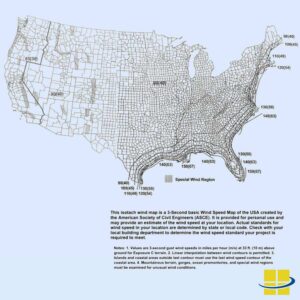

Luminaire and pole assemblies must be designed to maintain their structural integrity when subjected to wind forces. To make it easier to determine the wind speed in your specific location, the American Society of Civil Engineers has created a wind speed map shown on the right. These wind speed maps and design standards have been developed over many years through extensive research and historical data collection to ensure safe and effective structural design in various regions. To get an idea of the wind speed in your area, click on the image to download a full-sized PDF and then find your location. If your location falls between, or on, an isotach bar, use the next highest wind velocity (e.g., if your project is on the 90 MPH bar, assume your wind zone to be 100 MPH). Please note that this isotach map is provided for your reference and will only provide an estimate of the wind speed in your area. Understanding the wind pressure in your area is crucial for determining the appropriate light pole design.
Wind speed requirements vary based on the ground conditions and the specific project location. The wind load that a structure must withstand varies based on local environmental factors, including how the structure interacts with the ground and the area exposed to wind forces.
Wind Loads and Light Pole Design
Wind loads play a crucial role in the design of light poles, especially for outdoor lighting fixtures. Wind load refers to the force exerted on a light pole by wind, which can cause the pole to sway, vibrate, or even collapse if not properly accounted for. To ensure the structural integrity of the entire structure, engineers and designers must consider wind loads in their design calculations. Objects such as cars and airplanes also experience wind loads, and similar calculations are used to evaluate the effects on these structures.
Several factors influence the wind load on a light pole, including wind velocity, wind direction, and the shape and size of the pole. Wind velocity is particularly critical as it determines the magnitude of the wind force acting on the pole. The drag force, which is calculated using the drag coefficient, the effective projected area, and the wind speed, directly impacts the structure by increasing the wind resistance experienced by the pole. Wind speeds can vary significantly depending on the location, with coastal areas typically experiencing higher wind speeds than inland regions.
To mitigate the effects of wind loads, light pole designers employ various techniques:
- Material Selection: Using materials with high strength-to-weight ratios, such as steel or aluminum, helps minimize the weight of the pole while maintaining its structural integrity.
- Pole Shape: Designing the pole with a tapered or conical shape reduces wind resistance, making it more stable in high wind conditions.
- Installation Angle: Installing the pole at an angle can help reduce the wind force acting on it, enhancing its stability.
- Support Systems: Utilizing guy wires or other support systems can provide additional stability, especially in areas prone to high wind speeds.
Wind-induced movement, such as Aeolian vibrations, often affects the middle section of the pole, which can lead to potential damage if not properly addressed.
By carefully considering wind loads in the design of light poles, engineers and designers can ensure that outdoor lighting fixtures are safely and securely installed, even in areas with high wind speeds. This attention to detail helps prevent structural failures and ensures the longevity and reliability of the lighting system.
When Do Building Codes Affect Light Pole Selection?
Always. Building codes always affect light pole selection. Mountainous areas, coastal areas, and areas surrounding the Great Lakes are known to have wind velocities that are considerably higher than the surrounding areas, but the maximum wind velocity and wind ratings can even vary from one side of town to the other. Consequently, the reference map only provides an estimate of wind speed.
A customer in Florida used the address at his previous home to determine the wind speed of his new home in the next town over, where he was installing the new lighting. That new town had a much higher wind speed requirement than his current home, and the poles he ordered were not sufficient for his project.
To find out the wind speed requirements for your location, consult with your local building code department. Building code departments know what the standard is for your location, be it a standard for the entire town or a standard for your immediate location. Your lighting and pole assemblies will have to meet the building code for your specific location. In addition, codes may also apply to any structures that house lighting equipment, not just the poles themselves. Ensuring that your fixtures meet the required wind rating is essential for compliance and safety.
Safety Standards and Compliance
Adhering to safety standards is a non-negotiable aspect of any outdoor lighting installation. The American Association of State Highway and Transportation Officials (AASHTO) sets forth comprehensive guidelines for the design and installation of light poles and fixtures, ensuring that these structures can withstand wind loads and prevent pole failure. Transportation officials and engineers rely on accurate EPA calculations, which factor in wind speed, air density, and the projected surface area of the pole and its accessories, to determine the total EPA value for each installation.
This total EPA is then used to specify the necessary structural supports, ensuring that the pole can safely withstand the expected wind forces at the project site. Compliance with AASHTO standards and other relevant safety regulations is crucial not only for the safety of pedestrians and drivers but also for the longevity and reliability of the lighting system. By following these standards and performing thorough EPA calculations, you can minimize the risk of accidents, structural failures, and costly repairs, making safety a top priority in every lighting installation.
How is Data Used to Determine the Correct Light Pole Selection?
Poles are selected to meet specific requirements. The selection process also takes into account the specific lighting fixture being used to ensure compatibility and safety. When selecting a pole, it is important to focus on critical data such as EPA, wind rating, and mounting height to ensure the pole meets all necessary standards. Many companies have charts that help determine the correct pole. Once Access Fixtures knows the height at which the luminaires are supposed to be mounted, the weight of the luminaires, the weight of the mounting hardware, the total EPA, and the EPA wind rating, we can pair you with the perfect luminaire-pole setup.
Is an Engineer Required to Select the Correct Light Pole?
An engineer is typically not required to select the correct light pole, but you may need one to permit and install the correct light pole. Selecting the correct light pole can oftentimes be done by an engineer or light pole specialist at the company supplying the pole, taking into account the fixture's wind rating. As long as all the criteria, such as wind speed for the location, total EPA of the luminaires and mounting hardware, weight of the luminaires and mounting hardware, and mounting height of the luminaires, are available, selecting the correct light pole is a straightforward exercise for a pole supplier.
An engineer may still be required to permit and/or install the correct light poles. Local soil conditions will determine the type of base/foundation required for your light poles; the municipal building code department for your location will have to decide if the base/foundation needs to be specified by an engineer. If it does, you would provide a combined design of the base and pole with the engineer’s stamp or signature. Providing an engineer-stamped design is a basic task performed by local engineers. The structural aspect of the design is crucial to ensure the stability and safety of the installation. Stamped drawings can typically be supplied for a small fee.
Speak to an Access Fixtures Lighting Specialist about Choosing the Outdoor Lighting Pole EPA
It is important to know what you’re buying. We’re here to give you all the information you need. We want to make sure you get the exact pole for your needs, your budget, and your goals. Understanding the projected surface area of your fixtures is essential for accurate EPA calculations and proper pole selection. If you have questions regarding lighting and light poles for your project, speak with an Access Fixtures lighting specialist today by calling (800) 468-9925.
Conclusion and Final Considerations
Choosing the right light pole for your project involves more than just picking a style or height; it requires a thorough understanding of wind loads, EPA calculations, and compliance with safety standards. By considering factors such as wind speed, air density, projected surface area, and the total EPA of your fixtures and accessories, you can ensure that your light poles are designed to withstand the expected wind forces at your location. Adhering to guidelines and consulting with lighting specialists or engineers will help you avoid pole failure and ensure the safety and longevity of your installation. Whether you’re working on a sports field, parking lot, or urban roadway, taking these steps will provide peace of mind and reliable performance for many years to come.
Wind, Weight, and EPA Frequently Asked Questions (FAQs)
What is Effective Projected Area (EPA) in light pole selection?
EPA refers to the total surface area of a light pole and its attachments as projected onto a plane perpendicular to the wind direction. It helps determine the wind load the pole must withstand to ensure structural integrity.
How is the total effective projected area of a light pole calculated?
The total EPA is calculated by adding the EPA of each attached component, such as lighting fixtures, brackets, and accessories, multiplied by their quantities. This combined EPA value is essential for assessing wind resistance.
Why is calculating wind load important for light poles?
Calculating wind load ensures that the pole and its fixtures can safely withstand expected wind forces at the project location, preventing structural failure or pole failure due to wind pressure.
Do local building codes affect light pole selection?
Yes, building codes often specify wind speed requirements and safety standards that must be met. It is important to consult local codes to ensure compliance and safety.
Is an engineer always required to select or install a light pole?
While an engineer may not always be needed for selection, their involvement is often necessary for permitting, foundation design, and installation to ensure safety and compliance with local regulations.
How do wind speed and air density affect light pole design?
Wind speed and air density influence the wind load acting on the pole. Higher wind speeds and denser air increase the force on the pole, requiring stronger structural design and accurate EPA calculations.
Can additional accessories affect the effective projected area( EPA) and wind load?
Yes, any accessories such as banners, signs, or additional brackets add to the total EPA and wind load, and must be included in calculations to avoid underestimating the forces on the pole.
What role do standards like AASHTO play in light pole selection?
Standards from organizations like the American Association of State Highway and Transportation Officials (AASHTO) provide guidelines for calculating EPA and wind loads, ensuring safety and compliance in design and installation.